I want my autism to be cured, by which I mean that I want some order of a mechanism to make it go away, or to reduce its effects. I do prefer the name ‘autistic spectrum disorder’ for the same reason the book does not like it, namely the use of disorder to signify disability.
I admire people who take the opposite view. I wish that I did feel that way. I advocate but thinking makes it so as an approach to living.1 So it is cool that someone would write a book like this, or something like Unmasking Autism, but my reaction, personally is to quote the esteemed jurist and say don’t piss on my leg and tell me that it is raining.
Some part of this is that I am profoundly hyposensitive rather than hypersensitive, and I see you, spellchecker, recognizing the latter and not the former. I am Bob Filber. My Autism Communications Badge is a Catherine wheel. I once lived in a bedroom community and I wilted; I would go stand by the highway in order to think. So for starters, I am coming from a position where the customary reasonable accommodations are the inverse of what I want.
I think that the extrovert/introvert discourse a few years back got overblown, so I feel wary of dipping back into it, but in that paring, I am an extrovert. I like people. I like talking to people. I like meeting new people. They are full of so many interesting things. I become depressed the day after a social event, not because I feel like am recovering from being overwhelmed, but because the downshift into the world of casual alienation of city life leads to a part of my mind throwing a tantrum.
One difficulty that I face in this is anxiety, but the right dosage of the right medication helps. I still have to work at keeping those feelings in check, but it is the difference between having a flashlight or not. Another difficulty I face is autism.
What this feels like is being on script when everyone else knows their lines. I have learned, quite well I would proffer, the methods of how to interact with people in an alistic manner. I am in some ways better at it, reading the room or seeing where a crowd is moving emotionally, probably because of my direct study.
But the scripts only exist to the extent that I have written them, and so when I find myself off-script, or more exactingly post-script, I hurt people and myself. More in omission than commission, but both happen. I do not react in a manner to communicate my intentions, or in a manner that receives other’s intentions. I prize friendship, love, and sociability above all else, but I can never get there.
There is an XKCD comic that I think about when I think about my diagnosis:
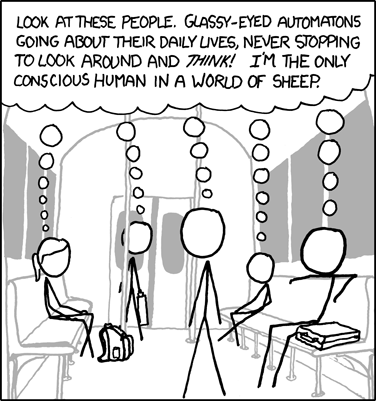
My diagnosis felt like the opposite. I had attributed my feeling like someone looking for his people as a persisting illusion of teenage angst. I tended to blame my social and romantic failure on material factors. Earlier in my life, it drove me to create elaborate social networks around me.2 I did not think it was a thing, or if it was a thing, it was something that everyone else felt. I still think that we all feel something like that from time to time.
The usual narrative about getting diagnosed is supposed to be that you now have a name for this thing that explains why it is you are why you are. Maybe even a sense of new identity, people you can identify with. For me, it made what I assumed was a temporary problem permanent. We all exist by the grace of others, but this was too much.
I joke about how a well-adjusted individual would not write this blog. I do not mean that my project is deranged3 or dangerous. I mean that reading and writing like this is an edible fruit from the choking weed that is my ASD. I do not mean that in an ‘autism is my superpower’ sense. I do not think anything that I do here relates to that, like some people may talk up their hyperfixations. I could mean it in a sense of needing to do something, as opposed to drinking whisky or pondering my Steam queue.
Instead, the way I mean it is, after years of trying to build the life that I wanted, I became resigned to focus on things that could not be taken away. So much of what I wanted to do, or wanted to create, required people. I have lots of friends, but they love me despite of me. And so, after decades of things not giving back to me what I wanted, I found two, maybe three things, to work at, all of which involve other people, but do not require other people,4 and where I do not consider other people. This is that.
Am I wrong? There are too many variables for any reasonable counterfactual. But I feel like, even in meeting my goals here, I will still feel it a consolation prize. And that is the autism, that is why I cannot have nice things.
I am at a peace of sorts about it. But when I read a book like this, as good as it is in general, as much as it disagrees with me, I feel much more simpatico to the fretful parents than I do to fellow autistic people. The point, other than catharsis, is to emphasize this as a matter of the book’s quality. I can disagree and still feel heard by the book, even with the book having a clear side. This is not something that I often feel about similar books, and so stands in the author’s credit.
- It is not without reason that Hamlet uses it to justify his bad mood and not as a morning affirmation repeated to the mirror. ↩︎
- I stopped, I think, because as I became more socially conscious, it felt less seemly. ↩︎
- Contra. trying to cover non-fiction as a topic is unwise and impossible. ↩︎
- At least, as of this writing. Owing to the way that these posts come out based on book publication schedules, this may stand as outdated: the Red Queen rules all. ↩︎
 CITATION HEEDED